Mushroom lamp
Date: April 2024
Class: Form - Atlas 3200
Context: Digital fabrication course final focused on creating functional, three-dimensional objects with careful attention to form, structure, and manufacturability.
Goal: Create a table lamp at least 8 inches tall using primarily PLA/3D-printed materials that provides soft ambient lighting.
Tools used: 3D printer (PLA), bulb + socket hardware, measuring tools, sketching materials, SketchUp, heat shrink, soldering materials


Overview
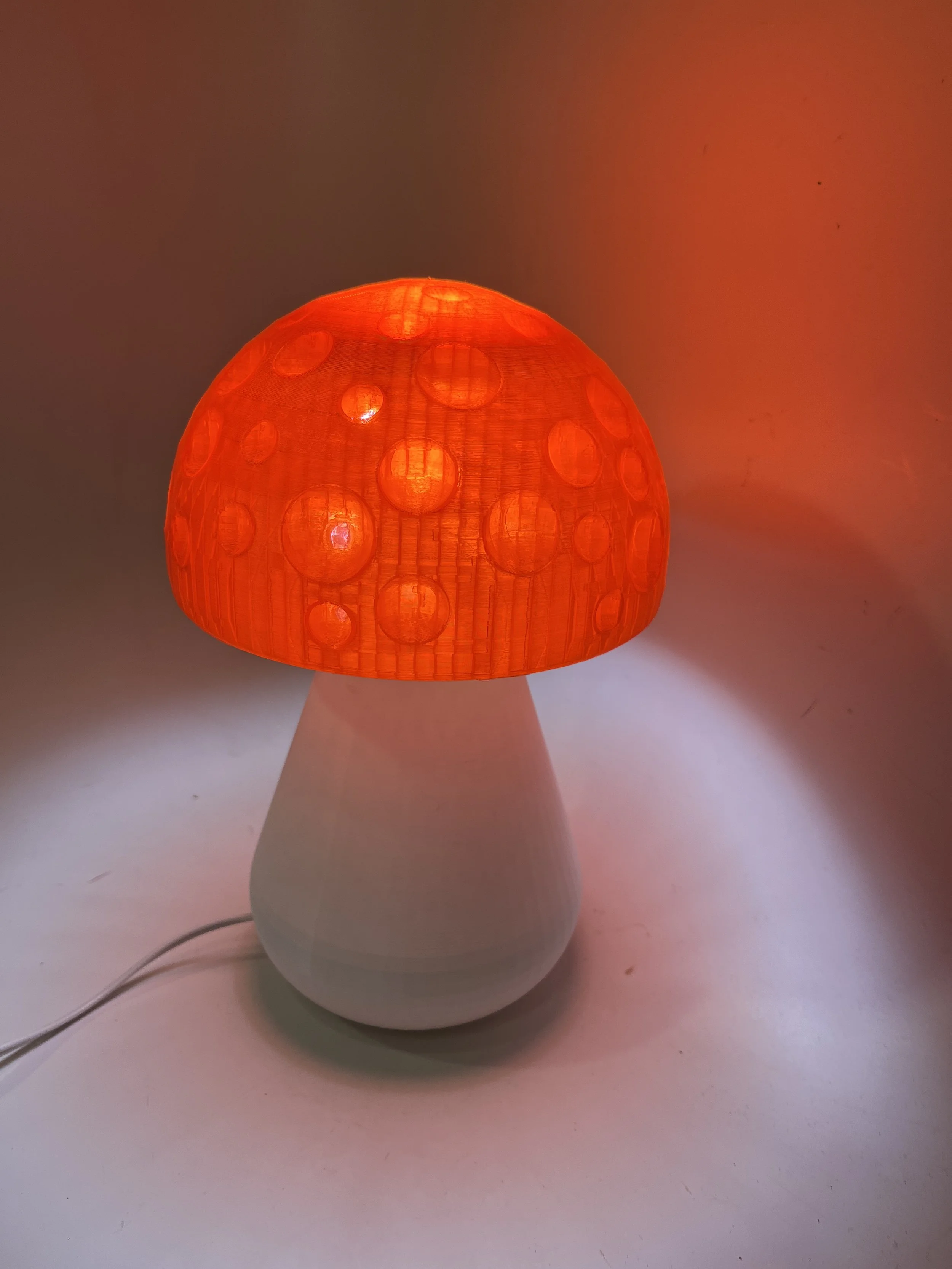
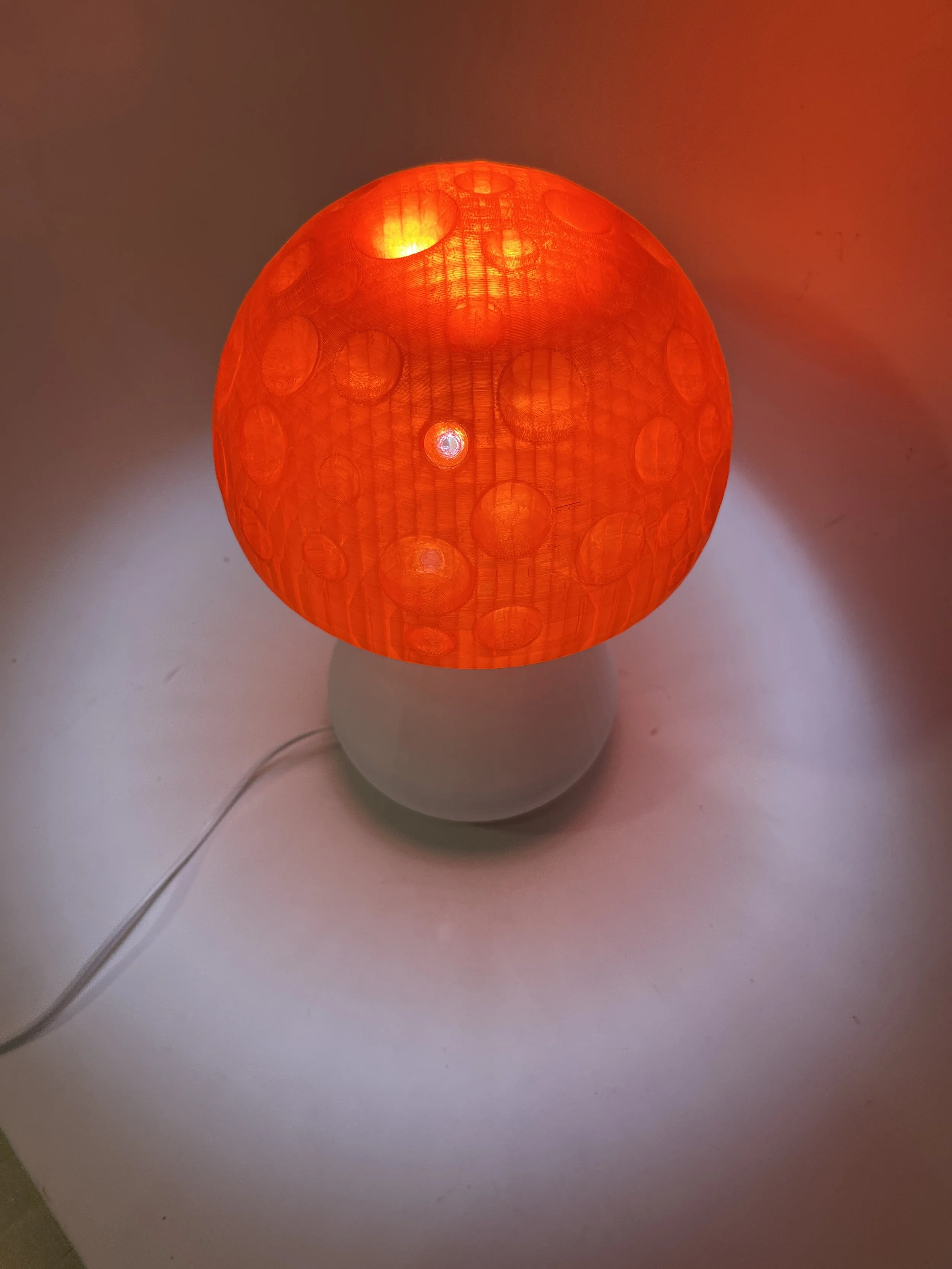
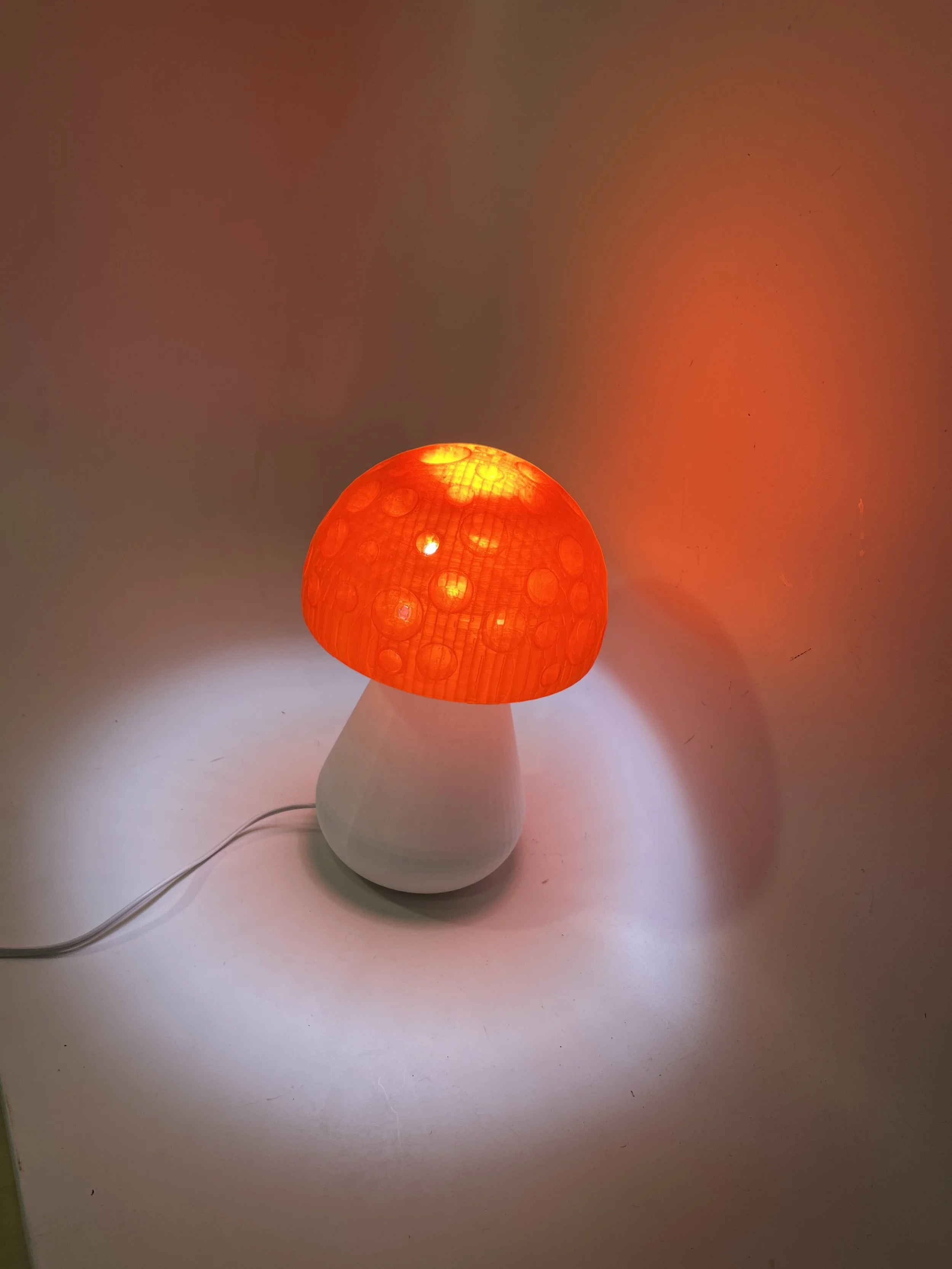
The Mushroom Lamp is a fully 3D-printed ambient light designed to mimic the soft organic geometry of a wild mushroom. Its rounded cap, radial gills, and minimal base were digitally sculpted, prototyped, and refined through iterative CAD modeling. While deceptively simple at first glance, the lamp required thoughtful engineering to balance organic form, structural stability, and internal space for wiring.
The final piece functions as a small-area ambient light, glowing softly from within the mushroom cap and creating a gentle, atmospheric presence. It was fabricated entirely using PLA and additive manufacturing techniques.
Process
1. Sketching & Natural Form Study
Before touching CAD, I gathered visual references of mushrooms — focusing on:
Cap curvature
Gills pattern and density
Stem proportions
How light scatters through thin surfaces
I sketched multiple variations, experimenting with how dramatic or subtle the curvature should be, and how wide the base needed to be to remain stable without looking bulky.
3. Prototyping — Testing Thickness, Fit, and Stability
I printed small sections of the cap and gills to test:
Wall thickness for diffusion
Interlocking fit of connectors
Stability of the base
Key discoveries:
Cap too thick → light too dim
Gills too thin → snapped during assembly
Base too narrow → lamp wobbled
Through each iteration, I adjusted curvature, thickness, and connection dimensions.
Outcome
2. CAD Modeling — “The cap makes or breaks it.”
The lamp is composed of three major pieces: cap, gills (internal support + light diffusion), base (with integrated cord hole and internal cavity)
Cap: The cap required rotational symmetry but organic variation. I modeled it as a smooth, slightly domed surface with rounded edges that would diffuse light without excessive thickness.
Gills: The gills were the trickiest part. I built them as radiating ribs that: support the cap structurally, create interesting shadow patterns, contain a central support for the light source
The gill structure needed to print without fragile overhangs — a balancing act between aesthetics and manufacturability.
Base: The base houses the wiring and LED mount.
Features include: Cord exit hole, Internal support connector, Hollow interior for light placement
This section required the most tolerancing work to ensure a snug, wobble-free connection with the gills.
4. Fabrication — The Final Print
Once the model was refined, I sliced the pieces and printed them on an FDM 3D printer using PLA.
Print notes:
No supports needed for the cap
Gills print required slow speed to prevent layer shift
Base printed with higher infill for weight
Assembly
Gills and stem fitted snugly via press-fit joint
Cap secured over gills with internal connector
LED + cord installed through bottom opening
Entire lamp closed and tested for even lighting
The moment it lit up felt like a small victory.
A fully functional mushroom-shaped ambient lamp with: soft internal glow, clean and organic geometry, stable 3D-printed construction, neat internal wiring, a whimsical presence that feels both sculptural and practical
Its form successfully captures the delicate, natural feel of a mushroom while maintaining the constraints of 3D printing.
What I learned
Managing printability while modeling organic forms
How light interacts with surface curvature and material thickness
Importance of tolerances in 3D-printed components
Designing for assembly (not just appearance)
How biomorphic design can be functional without overcomplicating the form
Reflection
This project strengthened my understanding of the relationship between form, material, and light. I learned that organic shapes are surprisingly technical when translated into manufacturable geometry. The lamp taught me how to model with intention—ensuring every curve and thickness serves both aesthetic and functional purposes.
Personal insight
I realized I love designing objects that feel alive. The mushroom lamp blends nature, light, and digital fabrication in a way that feels personal and satisfying. It’s a reminder that even simple household objects can feel magical when designed thoughtfully.